If you are searching for Pilates in Scottsdale, you will quickly discover that not every Pilates studio offers the same experience. You may find large Reformer classes, athletic Pilates, contemporary Pilates, private instruction, and fully equipped Classical Pilates studios—all using the Pilates name. So how do you know which approach is right for you? The most important differences are not simply the introductory price or whether a studio has Reformers. Look at what method is being taught, how the instructors are trained, how sessions are structured, and whether the studio uses Pilates as a complete system or primarily as a fitness format.
At TruForm Pilates in North Scottsdale, we teach Classical Pilates as a complete system. Our goal is not simply to make a workout more intense. It is to help clients build strength, mobility, control, coordination, and body awareness through a method that develops progressively from one session to the next.
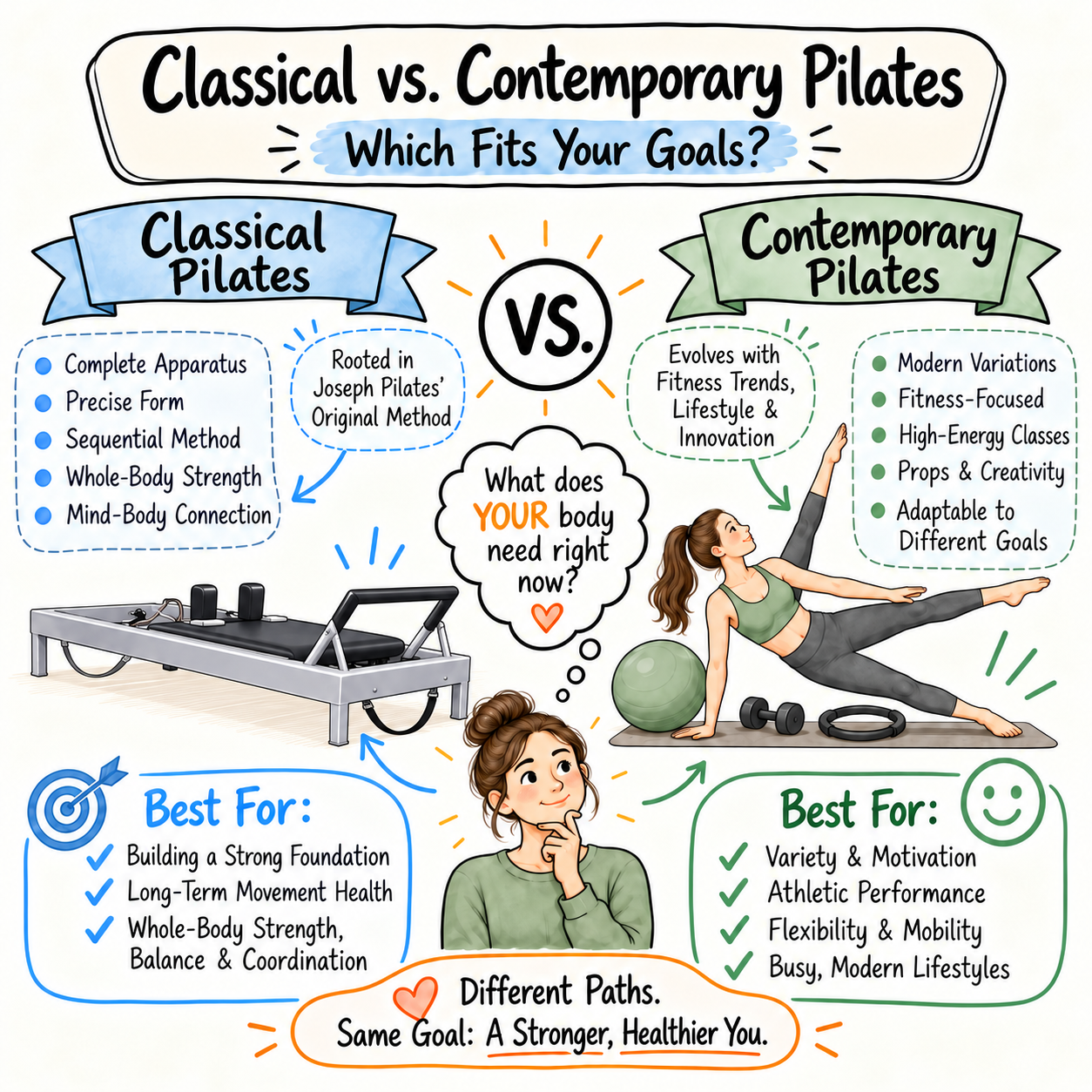
What Is Classical Pilates?
Classical Pilates is rooted in the original system developed by Joseph Pilates. Rather than treating Pilates as a collection of unrelated exercises, the Classical method follows a purposeful order and progression. Exercises build upon one another, and skills developed on the Mat or one piece of apparatus carry into work throughout the rest of the studio. As your practice develops, you begin learning how to connect to your powerhouse, maintain awareness of your box, create length and two-way stretch, articulate the spine with control, and connect the arms and legs to your center. That progression is intentional.
The Reformer is an important part of the method, but it is not the entire system. A fully equipped Classical Pilates studio also uses apparatus such as the Cadillac, Wunda Chair, High Chair, Small Barrel, Ladder Barrel, Ped-o-Pul, and Mat. Each provides a different combination of support, resistance, assistance, and feedback. Together, they all form one interconnected method.
What Is Contemporary Pilates?
Contemporary Pilates developed from the original Pilates method but may incorporate newer approaches to exercise, rehabilitation, movement science, props, sequencing, or fitness programming. Because contemporary Pilates is a broad category, the experience can vary greatly from one studio to another. Some contemporary studios remain closely connected to traditional Pilates principles. Others use the Reformer primarily as part of a fitness-based workout. Neither approach is automatically right or wrong.
The important question is whether the experience matches your goals and the type of instruction you want. If you enjoy fast-paced group workouts, frequent exercise changes, and a fitness-oriented atmosphere, a contemporary Reformer class may be a good fit. If you want individualized corrections, structured progression, and the opportunity to work throughout the full Pilates system, Classical Pilates may better match what you are looking for.
Classical Pilates Is More Than Reformer Pilates
The Reformer is probably the piece of Pilates equipment most people recognize, but Joseph Pilates created an entire system of apparatus.
The Reformer uses spring resistance and a moving carriage to develop strength, control, coordination, and length.
The Cadillac can provide both assistance and resistance and allows movements to be explored in ways that are not possible on the Reformer.
The Chairs challenge strength, balance, and control on a smaller base of support.
The Barrels provide another environment for developing spinal movement, hip opening, length, and control.
An exercise that is difficult to understand in one place may become clearer somewhere else in the system. That is one of the advantages of working in a fully equipped Classical Pilates studio: your instructor has more options for helping you develop the skill you need. The goal is not to use every apparatus during every session. It is to use the right apparatus at the right time.
How Much Individual Attention Do You Want?
When comparing Scottsdale Pilates studios, session size can dramatically change your experience.
Private instruction gives your instructor the opportunity to work one-on-one with you, select exercises and apparatus for your goals, and make corrections throughout the session.
Semi-Private Sessions allow two clients to work together while still receiving personalized guidance.
Small Group Classes at TruForm Pilates are limited to four clients. This allows clients to develop greater independence while still giving the instructor the opportunity to observe, cue, and correct each person.
At TruForm Pilates, your Pilates practice does not have to fit into only one format. We can create customized bundles combining Private, Semi-Private, and Small Group Sessions.
Call the studio for pricing details and help choosing the right combination for your goals and schedule.
Not sure where to start? Begin with individualized instruction. We can help you determine which session format makes sense as you become familiar with the method and equipment.
How Should a Beginner Start Pilates?
You do not need to know the exercises, equipment, or Pilates terminology before your first session. Your instructor is there to teach you.
Your first sessions give us an opportunity to learn about your goals, movement history, previous experience, and any considerations that may influence your program. You begin with foundational exercises and gradually learn how to use the apparatus and understand the language of the method.
As your strength, confidence, and familiarity with the system grow, your instructor can help determine whether you should continue with Private instruction or begin adding Semi-Private or Small Group Sessions. This is one reason we do not believe every new client should simply be placed into the next available large Reformer class.
Pilates is a skill, and good instruction gives you time to learn it.
Look for Progression, Not Just Variety
A workout can be different every time without actually helping you progress.
Classical Pilates uses repetition with purpose. You return to familiar exercises, but what you are able to do within them changes. You may discover more length, greater control, stronger connections, improved range, smoother transitions, or a deeper understanding of where the movement should come from.
Sometimes your instructor will take you to another apparatus to help develop something that is missing. That is why foundational exercises continue to have value even as your practice becomes more advanced.
You are not simply collecting harder exercises. You are developing the skills that allow you to perform the work better.
How Often Should You Practice Pilates?
Consistency matters because Pilates is learned through repetition. At TruForm Pilates, we generally recommend practicing two to three times per week so you can return to exercises while the corrections and sensations from the previous session are still familiar.
Your schedule does not need to consist entirely of Private Sessions. Depending on your experience and goals, you may combine Private, Semi-Private, and Small Group instruction. See How Often Should You Do Pilates?
Questions to Ask When Comparing Pilates Studios in Scottsdale
Before you book, ask:
Does the studio teach Classical Pilates, contemporary Pilates, or a fitness-based Reformer format?
Are instructors trained across the full Pilates system or primarily on one piece of equipment?
Does the studio offer the complete apparatus or mainly Reformers?
How many clients are in each class?
How are new clients introduced to the method?
Is there a clear progression as your skills improve?
Those answers will tell you much more about the experience than an introductory offer alone.
What Makes TruForm Pilates Different?
TruForm Pilates was created for clients who want a more personal approach to Pilates in Scottsdale. Our North Scottsdale studio is built around the Classical Pilates method, small session sizes, and the complete apparatus system.
At TruForm Pilates, you will find Private and Semi-Private instruction, Small Group Classes limited to four clients, individualized corrections, and the opportunity to work throughout the Classical system rather than being limited to the Reformer. We believe effective Pilates instruction goes beyond telling you where to place your arms and legs.
Your instructor should understand how the exercises relate, recognize what you need, and know where in the system to take you next. Sometimes that means progressing to something more challenging. Sometimes it means returning to foundational work, changing apparatus, adding support, or refining an exercise you already know.
The goal is not simply to make the workout harder. The goal is to help you move better.
If you would like to learn more about our approach, see Why Choose TruForm Pilates Scottsdale?
Which Type of Pilates Is Right for You?
There is no single Pilates format that is right for everyone.
If you primarily want a large, energetic fitness class, a contemporary Reformer studio may fit what you are looking for.
If you want more individualized attention, structured progression, access to the complete apparatus system, and the opportunity to develop a deeper understanding of Pilates over time, Classical Pilates may be the experience you are looking for.
The important thing is to understand what you are choosing—and to choose a studio whose approach matches your goals.
Experience Classical Pilates at TruForm Pilates Scottsdale
If you are searching for Classical Pilates, Pilates Classes, Pilates Scottsdale, or Scottsdale Pilates and want a smaller, more individualized studio experience, we invite you to experience TruForm Pilates.
Located in the McDowell Mountain Ranch area of North Scottsdale, TruForm Pilates offers Private, Semi-Private, and Small Group Classical Pilates instruction in a fully equipped studio.
You do not need to decide which format is right for you before you arrive. We can help you determine the best starting point based on your goals, experience, and schedule.
Send us a message or visit TruFormPilates.com to get started.